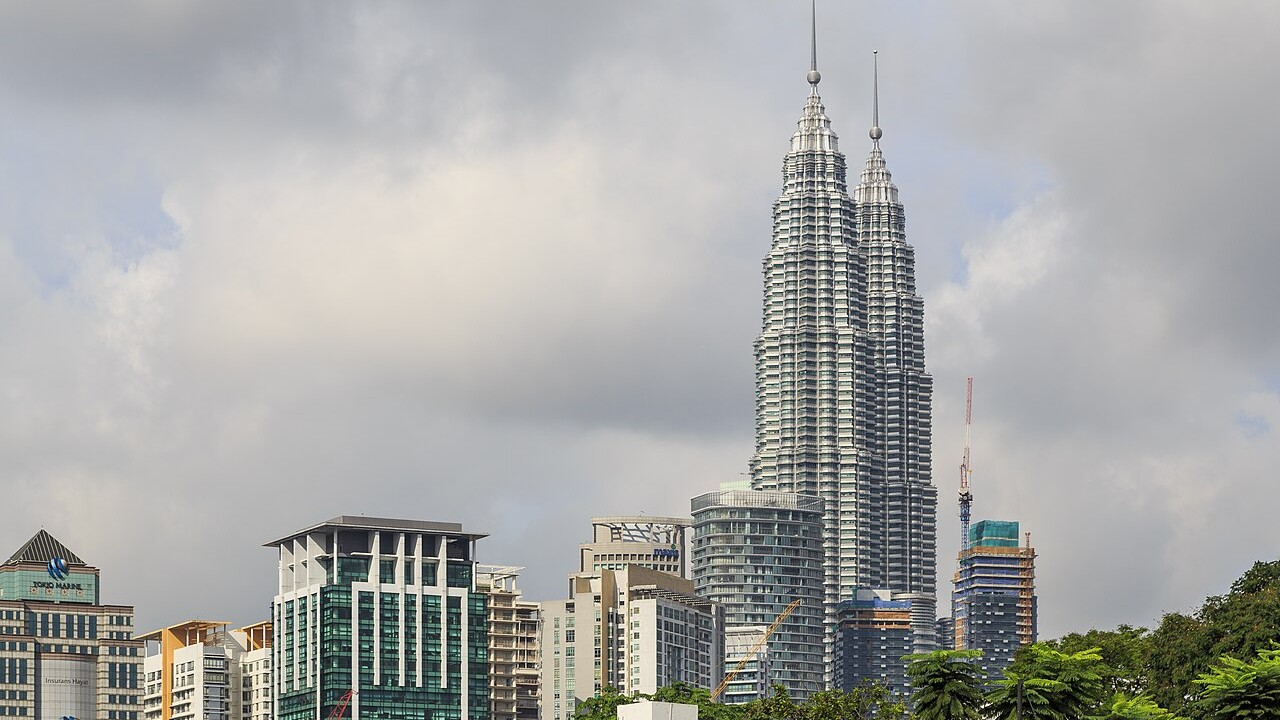
Why Concrete, Not Steel?
Here\'s a question that stumped most people in the 1990s: why would you build the world\'s tallest buildings from concrete instead of steel? Every supertall skyscraper before the Petronas towers used a steel skeleton. Structural engineer Charles Thornton had three compelling answers.
First, concrete is heavy — and for very tall buildings, heavy is good. When tropical winds push against a 450-metre tower, a heavier structure resists the sway better, keeping the people inside comfortable rather than slightly seasick. Second, Malaysia had excellent concrete expertise but limited experience with the complex welded steel connections that supertall buildings require. Third, concrete could be sourced locally, while structural steel would need to be shipped from overseas at enormous expense. The result? The towers cost roughly 40% less than they would have in steel, and they\'re more comfortable to occupy on windy days.
The Star That Holds It All Up
Each tower\'s floor plan is an eight-pointed star — two squares rotated 45 degrees and overlapped, with semicircular bumps filling the inner corners. This isn\'t just beautiful; it\'s structurally brilliant. The star\'s sixteen points are natural locations for the heavy concrete columns that carry the building\'s weight. These outer columns, connected by horizontal beams at every floor, form a "tube" around the building\'s perimeter. Inside, a circular concrete core (containing the elevator shafts and stairwells) forms a second "tube." Together, the two tubes share the task of keeping the building upright.
The star shape also creates more usable floor space than you\'d expect. With a conventional circular or rectangular floor plan of the same area, a significant portion of the space near the core is difficult to furnish or use effectively. The star\'s irregular perimeter pushes usable space outward toward the windows, where natural light makes it most valuable. Roughly 60% of each floor is usable office space — competitive with buildings designed purely for efficiency rather than beauty.
The Floating Bridge
The Skybridge looks like it\'s rigidly bolted between the two towers, but it\'s actually floating. Here\'s why that matters. In strong winds, each tower can sway up to 500 millimetres at the top — about the length of your forearm. If the two towers sway in different directions simultaneously (which they do, because they interact aerodynamically), a rigid bridge would experience enormous forces that could damage both itself and the towers.
The solution is a set of spherical bearings at each end of the bridge, essentially giant ball-and-socket joints that allow the bridge to slide horizontally along steel rails as the towers move. The bridge also rests on massive support legs that extend down to level 29, but these legs themselves can slide on their bearings. The result is a bridge that moves with the towers rather than fighting them — an elegant solution to a problem nobody had ever faced at this scale.
Riding the Elevators
Getting 10,000+ office workers to their desks efficiently in a 88-storey tower is a transportation challenge comparable to running a small metro system. The Petronas towers solve it with 29 double-deck elevators per tower — each cabin has an upper and lower compartment serving odd and even floors, effectively doubling capacity in the same shaft space. A "destination dispatch" system at the lobby groups passengers by destination floor before they board, reducing stops and cutting average journey times.
The fastest elevators travel at 7 metres per second — about 25 km/h — reaching the highest floors in under 90 seconds. Three zones served by express elevators and sky lobbies reduce the number of shafts penetrating the full building height, freeing up space on upper floors for offices rather than elevator machinery.
Keeping Cool in the Tropics
Kuala Lumpur sits almost exactly on the equator, with temperatures of 27–34\u00b0C year-round and intense solar radiation. Cooling two 88-storey towers in this climate requires industrial-scale air conditioning. Rather than putting cooling equipment on each tower\'s roof (adding weight and noise), the KLCC precinct uses a centralised district cooling plant that produces chilled water and distributes it through underground tunnels to every building. This system is about 15–20% more energy-efficient than individual building systems and eliminates the rooftop mechanical equipment that would otherwise clutter the towers\' elegant profiles.