It Started with a Horse Track
Imagine standing in the middle of Kuala Lumpur in 1990, looking at a sprawling horse-racing venue called the Selangor Turf Club. Horses gallop, spectators cheer, and bookmakers scribble odds. Now imagine someone saying: "Right here, we\'re going to build the tallest buildings on Earth." That someone was Mahathir Mohamad, Malaysia\'s charismatic and controversial fourth Prime Minister, a man who believed that if you wanted the world to notice your country, you had to give them something impossible to ignore.
The Turf Club was relocated, the land was cleared, and a competition was launched that attracted eight of the world\'s leading architects. Each was asked the same question: what should the signature building of a modern, Muslim-majority, Southeast Asian nation look like? Most submitted variations on the steel-and-glass towers that already dominated Western skylines. One did something different.
The Architect Who Listened
C\u00e9sar Pelli was born in Tucum\u00e1n, Argentina, and had built his reputation designing sleek corporate towers in the United States. But when he received the KLCC brief, he did something unexpected: he studied Islamic art. He visited mosques, examined illuminated manuscripts, and immersed himself in the geometric patterns that have decorated Islamic architecture for over a thousand years. What he found was the Rub el Hizb — an eight-pointed star formed by two overlapping squares — and he made it the foundation of his entire design.
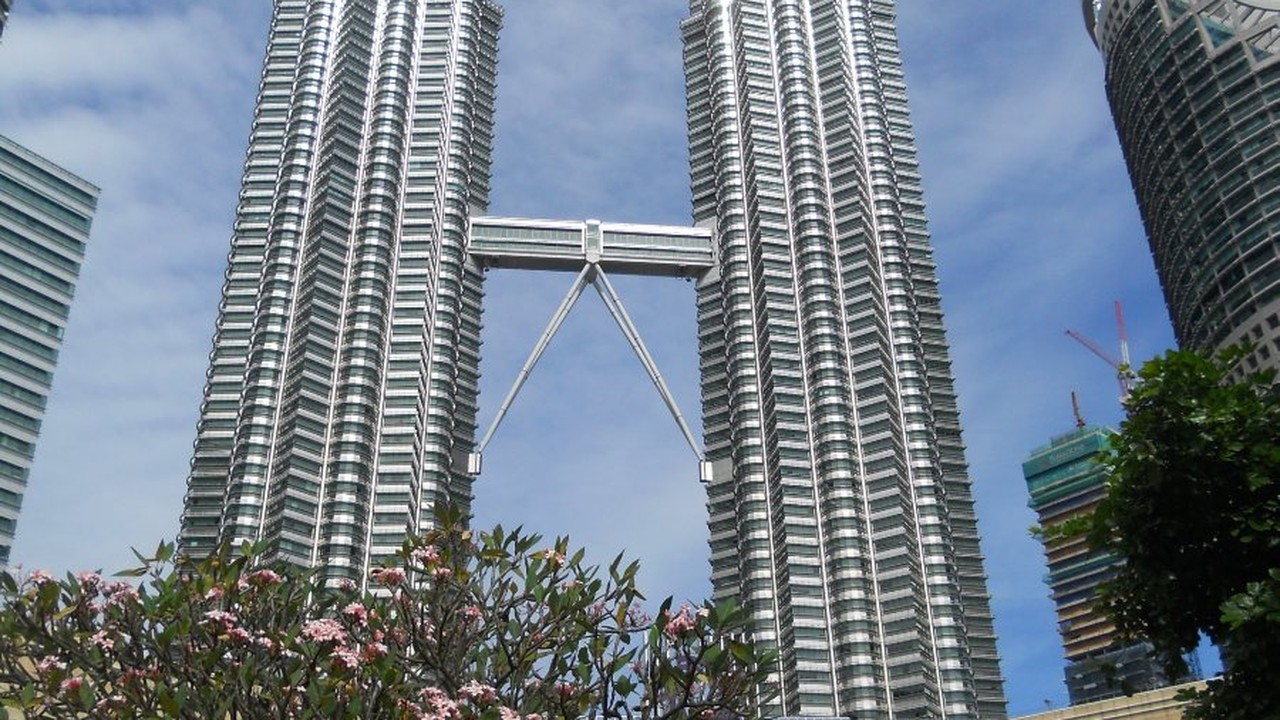
The result was unlike any skyscraper the world had seen. Instead of a simple rectangle or circle, each tower rose from a star-shaped base, stepping inward at intervals to create a profile that echoed the tiered towers of traditional Malay mosques. When Mahathir reviewed the eight competition entries, he is said to have pointed to Pelli\'s model and declared simply: "That one. That is Malaysia."
The Earth Has Other Plans
Construction began in 1993 with the kind of surprise that keeps engineers awake at night. Geological surveys revealed that the bedrock beneath the site was not flat but sloped dramatically, plunging to unreachable depths beneath one of the planned tower locations. The entire project had to be shifted 60 metres to the southeast — an enormous and expensive change that required redesigning underground infrastructure already in progress.
Even after the relocation, the foundations were extraordinary. Tower 2 required over 100 massive concrete piles driven up to 115 metres deep — some of the longest building piles ever created. Each tower\'s foundation slab consumed enough concrete to fill five Olympic swimming pools, poured continuously for more than two days. The workers who built these foundations knew that nobody would ever see their work, but they also knew that 452 metres of twin towers would stand on it.
The Great Race
In a move that stunned the construction industry, the developers hired two completely separate contractor teams: a Japanese consortium for Tower 1 and a Korean consortium for Tower 2. Working side by side on adjacent sites, the two teams developed an intense but friendly rivalry. The Japanese team favoured careful, methodical progress; the Koreans adopted an aggressive automated formwork system that gained speed in the upper levels.
At peak construction, each team was completing a new floor every four days. Over 7,000 workers from more than 20 countries swarmed the site daily. Cranes lifted materials hundreds of metres; concrete was pumped to heights that tested the limits of existing technology. The drama intensified when surveyors discovered a slight lean developing in Tower 2 — invisible to the naked eye but measurable with precision instruments. The Korean team halted, corrected, and resumed, losing several weeks but maintaining the structural integrity that would keep the tower standing for centuries.
Finished Just in Time
By 1996, both towers had reached their full structural height, and the stainless steel pinnacles — each 73.5 metres tall and weighing 176 tonnes — were lowered into position, bringing the total height to 451.9 metres. The Petronas Twin Towers were officially the tallest buildings in the world. The official inauguration came on 28 August 1999, barely two years after the Asian financial crisis had nearly collapsed the region\'s economies. That Malaysia completed these towers during a financial catastrophe that forced other countries to abandon construction projects made the achievement all the more remarkable — and all the more meaningful to the millions of Malaysians who saw them as proof that their country\'s spirit could not be broken.